• Skip to primary navigation
  • Skip to main content

The Nourished Path

Nutritional Therapy and Coaching in Herefordshire

  • Home
  • About Emma
  • Integrative Coaching
  • Nutritional Therapy
  • Functional Tests
  • Contact

admin

What I Wish I’d Known as a New Mum (That My Mum Knew All Along)

July 14, 2026 by admin Leave a Comment

Someone asked me recently: If you could go back and become a new mum again, knowing what you know now, what would you tell yourself?

I sat with that question longer than I expected to. And somewhere between the obvious answers and the funny ones, I landed on something I wasn’t planning to write about at all. But here we are.

The Stuff Everyone Tells You (BUT Nobody Actually Does)

Let’s start with the easy bit, the bit every mum, midwife, mother-in-law and stranger in the Sainsburys will tell you: sleep when the baby sleeps!

I heard it a thousand times. I nodded. I said “yes great advice” while internally filing it under things-other-people-do. And then the baby would finally drift off and I would fold washing, start restacking the dishwasher for the 100th time or reorganise a cupboard like it was an emergency. Anything and everything, except lie down and rest my actual body, which had just spent the night feeding, soothing and doing that thing every new mum does where you hold your breath every twenty minutes just to check the baby is still breathing. Tell me without telling me you didn’t do that!

If I could go back, I’d tell myself the washing will still be there. The power nap will not. Trust your body. It is begging you for ten minutes and the floor will still be dirty in ten minutes time.

But that’s not actually the thing that stuck with me most when I really thought about this question.

The Thing I Actually Wish Someone Had Reminded Me Of: Food

I come from a big, loud, wonderful Italian family where food was never just food. Food was the whole conversation. So you’d think, of all people, I would have got this right from day one with my own kids.

I didn’t.

When it came to weaning, I went so basic it’s almost embarrassing to admit. Bland purees and the occasional pouches, the path of least resistance. Me, someone who grew up watching my brothers and dad fighting over who got to suck the marrow out of the bone, but raising my own babies on food with zero personality.

It wasn’t until years later and doing what I do now and THAT question that it hit me: I’d forgotten everything my mum spent a lifetime trying to teach me.

Dinnertime and Sucking Prawn Heads

Growing up, dinner wasn’t a meal, it was an event. My mum would cook things like ossobuco and my brothers and dad would practically arm-wrestle over the bone marrow like it was their last supper. My dad sucking prawn heads like it was a delicacy (it is, apparently), completely unbothered that the rest of the table found it slightly horrifying. To him, that “head-gunk” all that concentrated fat and flavour and frankly brain was the best part. The delicacy. The jackpot!

As a kid I just thought we were a chaotic, slightly feral, over-the-top Italian family having a normal Tuesday dinner. Looking back now, I realise it was never chaos. It was connection, wearing chaos as a disguise.

My mum used to say something I didn’t understand until I had kids of my own: that the best feeling in the world is watching everyone wipe their plate clean. Not because the dishes were done. Because it meant we were fed, we were happy and for one hour at that table, everyone she loved was exactly where she could see them, mouths full, voices louder than they needed to be, completely unafraid of what was on their plate.

That was the lesson. Food wasn’t fuel it was how she loved us. And when we were sick, it was medicine too. A chicken carcass, a handful of pastina, vegetables and time. That pot on the stove was her answer to everything. Our very own Mary Poppins except her spoonful of medicine was simply. No fuss. No drama. Just broth.

Where I Lost the Plot (and Got It Back)

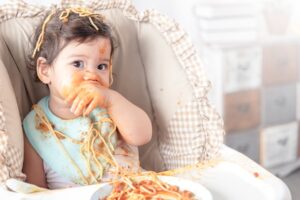
I wish, when my babies started eating, I had gone back to those roots instead of falling into the fear that so much of modern parenting quietly hands you, fear of choking, fear of allergens, fear of mess, fear of “what if they don’t like it,” fear of basically everything that used to just be called dinner!

This isn’t a dig at anyone, and it’s definitely not judgment, it’s just a reflection with the gift of hindsight, that maybe our Nonna’s and our mums had something figured out that we’ve slowly let slip through our fingers as life got busier, more anxious and more sanitised. Food back then was food. It was real, it had bones in it sometimes, it occasionally fought back a little and nobody died of it. Mostly, it was made with love, eaten together and never, ever rushed.

What I’d Actually Tell New Mums Now

If I could sit my younger, exhausted, prawn-head-avoiding self down for a chat, here’s what I’d say:

Sleep when the baby sleeps. Properly. The washing isn’t going anywhere and neither is the dust.

Trust your instincts before you trust the internet.

The baby bubble disappears faster than you can possibly imagine, so let yourself sit in it instead of cleaning your way through it.

And feed your children like your ancestors fed you with flavour, with culture, with a bit of mess and a bit of bone, sitting around a table where everyone is loved warts and all.

My mum isn’t here to ask any of this anymore. But every time I cook something with too much garlic, or watch someone at my table lick their fingers after dinner, I feel like she’s still teaching me. Just in a kitchen with ingredients now, instead of in words.

So that’s my answer. Sleep more. Worry less. And for the love of God, give the kids the bone marrow and find your way back to the table.

Filed Under: Family life

The Beige Years (Or: How I Survived a Toddler Who Would Only Eat Toast)

July 13, 2026 by admin Leave a Comment

One small boy eating bread with peanut butter. Portrait of a child taking a bite of toast carb food in morning breakfast or snack

There is a photo somewhere of my middle child, aged two and a half, sitting at the table in front of a plate of homemade lasagne — the proper kind, the kind my mum would have approved of — eating a single slice of dry toast he had somehow negotiated instead.

I remember taking that photo thinking, one day this will be funny.

It took about six years, but here we are.

The Menu of a Small Beige Dictator

For roughly eighteen months, my son ate the following: toast (white, no crusts, butter but only if invisible), plain pasta (no sauce, don’t even THINK about sauce), bananas (but only whole — a snapped banana was a ruined banana), and those little breadsticks that are basically air in stick form.

That was it. That was the menu.

And I — someone raised on ossobuco and octopus and vegetables that still looked like vegetables — stood in my kitchen every evening quietly panicking that I had somehow broken him.

I googled things at 2am that no rational person would google. I bought cookbooks with titles like Hidden Veg Heroes. I blitzed courgette into things until my blender begged for mercy. I once grated carrot so finely into a tomato sauce that it was essentially a rumour, and he STILL found it.

Tell me without telling me you’ve served the same meal four different ways in one week.

What My Mum Would Have Said (If I’d Asked Her)

Here’s the thing I understand now that I didn’t then: nobody in my family growing up ever asked a child what they wanted for dinner. Not once. Not out of unkindness — out of complete, blissful confidence that dinner was dinner, the table was the table, and everyone would be fine.

There was no children’s menu at my mum’s table. There was one pot, one loaf of bread and about nine opinions. If you didn’t fancy something, nobody wrestled you. Nobody made an aeroplane noise. The food just sat there being delicious while everyone else made a happy racket around you, and eventually — usually out of pure fear of missing out — you tried it.

No pressure. No bribery. No “just three more bites and you can have pudding.” Just food, repeated exposure and a table where eating looked like the best fun in the room.

Turns out my mum was doing responsive feeding decades before anyone gave it a name. She just called it dinner.

The Bit That Actually Helped

If you’re in the beige years right now, first: pour yourself something nice, because you are doing better than you think.

Then, a few things I wish someone had told me over the toast:

Their job is deciding whether and how much. Your job is deciding what and when. The moment I stopped trying to control the eating and just kept quietly offering, everything got calmer — including me.

Keep putting it on the table. Not on their plate, necessarily — just on the table. Research says it can take ten, fifteen, sometimes more exposures before a child accepts a new food. My son needed roughly four hundred for tomatoes. He eats them now. Voluntarily. In public.

Eat with them, not at them. Kids learn to eat by watching us enjoy food, not by being supervised like a small hostage negotiation.

A beige phase is a phase, not a personality. Almost every toddler does this. It is developmentally normal, wildly annoying and — I promise — temporary.

The Plot Twist

That toast-only child? He asked me last month if we could make risotto “the proper way, with the stirring.” He stood at the hob for twenty-five minutes, stirring, tasting, adding parmesan with the seriousness of a man defusing a bomb.

Somewhere, my mum was absolutely howling.

So if tonight’s dinner gets rejected in favour of a dry slice of toast, take the photo. Keep the faith. Keep setting the table.

The beige years end. The table stays.

Filed Under: Family life

My Nonna Was Doing Gut Health Before It Was Cool (She Just Called It Lunch)

July 13, 2026 by admin Leave a Comment

Italian food background. Healthy eating. Top view

Everywhere I look at the moment, someone is selling me my own childhood back at a premium.

Bone broth in chic little pouches. Fermented vegetables in jars with minimalist labels. Sourdough with a backstory longer than mine. “Thirty plants a week” trending like it’s a new invention and not just… how my Nonna did the shopping.

And listen – I’m delighted. Truly. As someone who now works in nutrition, I am thrilled that gut health has finally had its moment. I just can’t help laughing, because the wellness industry has spent the last decade rediscovering, rebranding and re-selling what was bubbling away on my family’s stove every single week of my childhood. For free. In a pot older than me.

The Original Gut Health Protocol

Let me describe the scene. A Sunday. My mum’s kitchen. On the hob: a pot of beans that had been soaking since approximately the dawn of time. Next to it, a broth made from a chicken carcass that had already fed us once and was now, in its second act, becoming medicine.

In the fridge: leftovers being reinvented, vegetables in various states of being “used up,” and something pickled that nobody could remember starting.

On the table, always: bread with actual structure, olive oil, and whatever was growing, cheap or in season — which meant we ate differently in October than we did in June, without anyone calling it “seasonal eating” or charging us extra for it.

Beans, lentils, greens, garlic, tomatoes, herbs, olive oil, fish on Fridays, fruit for pudding and a slightly alarming array of vegetables cooked until they surrendered. Fibre, ferments, polyphenols, plant diversity — the whole modern gut health checklist, achieved accidentally, weekly, by a woman who would have looked at the word “microbiome” and asked if it needed more salt.

Cucina Povera: Fancy Words for Not Wasting Anything

There’s a name for the way my family cooked — cucina povera, “poor cooking.” Peasant food. The cooking of people who couldn’t afford to waste a carrot top, let alone a carcass.

Nothing was binned. Bones became broth. Stale bread became panzanella, or breadcrumbs, or that soup that is essentially bread having a spa day in tomatoes. Parmesan rinds went into the minestrone like little flavour grenades. The odds and ends of vegetables — the leaves, the stalks, the bits modern recipes tell you to discard — were exactly the bits that went in the pot.

And here’s the joke of it: those unfashionable bits, the peels and stalks and leaves and bones, are where so much of the fibre and nutrition actually lives. My family wasn’t being virtuous. They were being skint. It just happens that skint and gut-healthy have an enormous overlap.

What This Looks Like on a Wet Tuesday in Britain

Now — before anyone panics — I am not suggesting you start simmering carcasses at 6am or fermenting things in your airing cupboard. You have a life. Possibly children. Possibly children who are IN a beige food phase (a story for another day).

But the Nonna principles translate beautifully to a normal, busy, British week:

Tins are your friend. Tinned beans, tinned lentils, tinned tomatoes — cucina povera would have LOVED a tin of butter beans for 60p. There is no prize for soaking.

One pot, many plants. A minestrone, a stew, a soup — chuck in every sad vegetable in the drawer. Variety matters more than perfection, and the soup does not judge.

Keep the rind, keep the carcass, keep the stalks. Broccoli stalks grate into anything. A chicken carcass and thirty lazy minutes make a broth that costs nothing.

Eat together when you can. Because — and this is the bit the supplement companies can’t bottle — how we eat matters too. Slowly, together, talking too loudly. My Nonna never once ate standing over the sink, and frankly she’d have strong words for how often I do.

The Moral of the Minestrone

My Nonna never read a study in her life. She couldn’t have told you what fibre does or named a single strain of gut bacteria. But she fed her family in a way that science is now spending millions confirming was right all along: mostly plants, lots of variety, nothing wasted, everything shared.

So by all means enjoy the fancy broth pouches — no judgment here, I’ve bought them too. But know that you don’t need a subscription to eat this way. You need a big pot, some tins, whatever vegetables are looking guilty in your fridge, and — ideally — people to eat it with.

The microbiome is new. The minestrone is not. Trust the minestrone.

Filed Under: Family life

Copyright © 2026 · The Nourished Path · Website by Primrose & Bee